Thursday, November 19, 2009

The Day I Met Tarzan


The day Johnny Weissmuller came to my hometown is near the top of my list of childhood memories. Boys from my generation grew up watching black and white movies of Tarzan on black and white television sets. And who was the greatest Tarzan? No question, hands down, Johnny Weissmuller was it. He was the voice, he had the rugged look. And, we insiders knew that he was a REAL hero. After all, in the 1924 and 1928 Olympics, he had won five gold medals as a swimmer. We knew that he really WAS Tarzan. No child of today could possibly understand the magnitude of seeing such a hero in the flesh.


I was too young to understand why a man who was an Olympic star in the 1920's, and a Hollywood star in the 1930's, 40's and 50's, would now be hanging out at a mobile home dealer's business in a small town in Virginia in the 1960's. When I came into his presence I found an older man, dressed as his Jungle Jim character of later years: pith helmet, khakis, and sunglasses. He was larger than life to me. I tried to strike up a conversation with him about his life as Tarzan, his sidekick Cheetah, and other things that a youngster would be thinking about. I remember that as he signed multiple autographs for me he seemed detached, and more than a little sad. He answered my questions in a polite, dignified manner. He was probably happy to have the attention of a young starry eyed boy rather than the glances of adults who probably could figure out something of what must have gone wrong. Years later, one can read of the multiple bad business decisions, and multiple wives that are a part of his story. Life seems to have gone all downhill after the Olympic days. He was in two unforgettable films after I saw him, you can't even find them on Netflix. I understand that he ended up in an unmarked grave in Acapulco.


All of us have to deal with the fortunes and misfortunes of this life: those we make and those we inherit. Our faith (or lack thereof) determines what we make of it. When life doesn't go our way, it is up to us to respond in a moral and faithful manner. We have to have the proper faith. If we believe in a false Christ, if our belief system is heretical in any way, our decisions (at best) will be flawed. Bad data in, bad data out. In Orthodoxy we have the true Christ, we have the true faith. And, having this, we must behave in the proper way.


Protopresbytyr Michael Pomazanky writes: Our "moral life is directed by the exploit of Christ on the Cross. This path is our personal struggle in the name of the Cross of the Lord…. The very concept of the spiritual Cross contains in itself not only the various forms of personal struggle, but also the involuntary sorrows of life which are accepted in humility before the Providence of God."


If we struggle in the shadow of the Cross we will triumph. No matter what comes: bad health, bad economy, faithless friends or family, we will triumph. We cannot allow ourselves to succumb to the amoral/immoral "easy" choices that appear before us. Oh, that reminds me of a great old movie, "The Devil and Daniel Webster" starring Walter Huston. But, that's grist for another day at the mill.

Saturday, October 10, 2009

Visit to a Desert Monastery


Wadi Qelt is a cleft in the Judaean Desert that looks the product of a gigantic hammer fallen from the heavens. I was anxious to go there. It has been home to Orthodox monks off and on since the 5th century. Besides being the scene of a massacre of monks by the persians, it is also said to be the place where Elijah hid in a cave and was fed by ravens. We drove as far as we could through the Judaen desert, and then parked the car in front of the entryway where we were met by bedouins on donkeys.
The initial descent is amazing as you snake your way down the side of
the Wadi. As we walked further we could see hundreds of holes in both sides of the sheer walls, the homes of monks over the last fifteen centuries. Incredibly, as we got closer to the bottom of the trail things began to turn green, and lush. I felt like Ronald Colman as he stumbled into Shangri-La. At the bottom of the walkway the shade shielded us from the desert heat. Crossing a bridge we began the ascent up the serpentine path to St. George's monastery.
A gatekeeper met us, and allowed entry. I was thankful that I was in the
company of two priests, because the door seemed to swing a little quicker and a little wider than it might have otherwise. The sound of the semantron signaled our arrival into the monastery. Some say that this was the instrument that Noah used to call the animals into the ark. We were greeted with cool water, lemonade, and dates as we cooled down and had our breath restored from the hike.
We were allowed to walk through the monastery, visiting the chapel, venerating the icons, the relics of slain monks, and the body of Fr. John the Romanian. A miraculous thing happened here, but that is the story of another. But, I will relate something that will always remain with me.
I was standing in the small gift shop admiring the hand made prayer ropes, and pointing at one I asked a priest monk who was standing there something about them. Thankfully, he misunderstood my question. Taking one of the ropes, he took it between his fingers, and began to pray his version of the Jesus prayer, first in Greek, and then in English. He began to tell me about the Jesus prayer in his own way. The Jesus Prayer in The Way of the Pilgrim was one of my first introductions to Orthodoxy. I have prayed the Jesus Prayer, but in my life I had neither prayed it, nor heard it prayed the way this monk prayed it. I will forever be touched by his words, and his handling of the rope. As I was about to leave I bowed and put my hands out for a blessing. He gave me a blessing, and then looking me in the eyes, he said, "What is your name?" I gave him my baptismal name, and he put his hands on my head and blessed me again, hugging me and kissing me on both cheeks. I will never forget that monk, his prayer, his blessing, and his love for me at that moment. I now know why men go to the desert. I see why they stay.

Tuesday, September 29, 2009

Up to Jerusalem 2009: Part Three


"A bag of monkeys" is how one of the desert fathers described the human mind. And, that is much how I feel anytime I am in the Old City of Jerusalem. It is very hard to keep focused on why you are really there, amidst the throngs of pilgrims and tourists, the various religious groups that live and worship in various parts of the city, the shopkeepers and hawkers who are trying to lure you in, the uneven pathways, the sounds and smells, and the ever present young Israelis packing machine guns. And, in the most holy of Christian places, The Church of the Holy Sepulcher , all of this is even more magnified. There is an energy, and a spiritual conflict that is ever-present wherever you are in the city.

My friend Ruairi asked me how my perspective on visiting Israel had changed since my first visit thirty years ago. I mentioned that my views on eschatology had created some change. Thirty years ago I was caught up in visiting Megiddo, and anticipating the events that evangelicals/dispensationalists have mapped out for us for that particular spot. Much of what I saw on that first trip was filtered through that eschatology. I could have said that I was caught up in a great zeal for the State of Israel at that time. Masada was a favorite stop. At the time I was steeped in Jewish studies at the University of Virginia, and vicariously a citizen of the modern State of Israel. "Never again, Masada" is a rallying cry for Israelis much the way that "Remember the Alamo" was for Texans. Reveling in the angst of modern Israelis seemed to be part of the package thirty years ago. To be future minded, pro-Israel, and Christian all seemed to make sense.
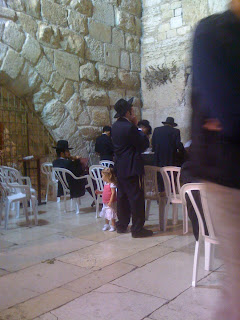
The Lord Jesus Christ told the Jews of His time that their house would be left to them desolate. When I go to the Wailing Wall today I see the desolation of Israel. With an amazing zeal the faithful perpetually pray there. Yet, the One they pray to passed through their midst. He still passes through their midst. Religious judaism failed when it rejected the God-Man and all that is left is the Wailing Wall from the time of its failure. The Pharisee Nicodemus made the right choice and the right time. Political judaism failed and Megiddo is its monument. Simon the Zealot made the right decision when he followed Christ instead of following his brothers to a suicide in the desert. I pray that God will be merciful to those pious Jews who pray fervently at the Wall.

Make no mistake, the State of Israel would be happy if every non-Israeli would disappear from their country. It is clear that their legal system is designed to remove non-Israelis from the land, one way or another. It doesn't matter whether you are a Moslem or not, a Christian or not, a law abiding person or not, or how long you have lived in the land. Legal loopholes are used to deport people every day. Non-Israeli dead are even being dug up from the Mount of Olives so that Israelis can be buried. They are welcoming Jews from all over the world with open arms, and as this policy continues more people will continue to be preempted from their land. The situation will only become worse with time and congestion. In 30 years my perspective has certainly changed on the State of Israel. That entity is no friend of the Body of Christ. It is systematically driving away as many Christians as it can, and making it intolerable, especially for Palestinian Christians, to live there. I am no longer a fan.

My perspective on the historical sites has changed as well. All of the sites in Old Jerusalem were discounted by our evangelical "completed Jew" tour guide. We walked by the door of the Church of the Holy Sepulcher and were told that "here is where the Catholics" say Christ rose from the dead. Of course, we were then directed to Gordon's (Garden) Tomb which has no historical connection to the life of Christ. The work of St. Helen in and around the city was completely discounted. Today I have a much greater appreciation for the historical sites. I am drawn to those places that contain the relics of the saints.

What has not changed for me is the importance of having a perspective on the land itself. The terrain and climate have not changed dramatically in the last two thousand years. I can visualize what it means to walk across or sail across the Sea of Galilee. I can appreciate the effort involved in walking "up to Jerusalem" especially when one reaches that brutal stretch of road from Jericho to Jerusalem. I marvel at how St. John the Forerunner, or Elijah, or untold numbers of monastics, could possibly live for any length of time in such a harsh desert climate. I know what the gospels means when they speak of Jesus leaving the city, crossing the Kidron Valley, and ascending the Mount of Olives…..

If you have never been to the Holy Land I encourage you to go. A visit can only help your faith to grow.

Monday, September 28, 2009

Up to Jerusalem 2009: Part Two


Two weeks ago I had the pleasure of participating in the Divine Liturgy of St. James in the Church of the Holy Sepulchre in Jerusalem. The setting of this service is actually a church within a church. The Greek Orthodox "chapel" (larger than many free standing churches) is found within the cavernous Church of the Holy Sepulchre between Golgotha and the Empty Tomb. A mark in

the floor of the nave actually marks the equidistant point. When a priest stands behind the altar he is actually looking out and can see into the empty

tomb. One receives the Body and Blood of Christ between the Cross and the Tomb. One is surrounded by beautiful icons on all the walls, and even above in the high domed ceiling. The choir voices filled the great space. There were perhaps a dozen men who served in and around the sanctuary as the Archbishop sat in the nave with the congregation.


This is the city where the church

began, this is the place where Christ's earthly ministry came to fruition. To be in that place for a Liturgy is unique, and extra special. I will never forget the experience.


One of those who accompanied me that day was Fr. Maximus Tatum. Yesterday, I had the pleasure of being in Portsmouth, Virginia at his first Divine

Liturgy of St. John Chrysostom for the new mission, Holy Myrrhbearers Orthodox Church. The service was

held in a borrowed chapel of another church, with few icons, a low ceiling, two other men in attendance and a small choir with a small congregation.

Portsmouth is a long way from Jerusalem, geographically and spiritually. To be in that place yesterday for a Liturgy was unique and special, and I will never forget the experience. You see, the Orthodox Church believes that whenever a Liturgy is held all of the saints are present, and that we are surrounded by the heavenly host. The same Body and Blood of Christ is partaken of regardless of where the service is held.


The words of the Cherubic Hymn are sung:

"We, who mystically represent the Cherubim,

And chant the thrice holy hymn to the Life-giving Trinity,

Let us set aside all earthly cares,

That we may raise on high the King of all,

Who comes invisibly escorted by the angelic hosts."


And, in addition, that service yesterday signaled the beginning of a new ministry as well as the work of a new minister. My thoughts and prayers are with Father Maximus as he begins this new work. May God bless all those who are a part of that ministry.

Thursday, September 24, 2009

Up to Jerusalem 2009: Part One


The jet lag is fading, and the myriad of remembrances of my time in and around the Old City are congealing into useable form. There has never been a city like Jerusalem in the history of the world. Where else have the major world religions and the world's greatest armies contended for so long, and so earnestly, and sometimes at the same time? Where else have children continued to play in the streets while crossbows or machine guns (depending on the century) continued to kill? From the time of Melchizedek and Abraham until now Jerusalem stands apart in the history of the world.

I was thankful to have been able to spend so many days in and around the city. Not only was I able to see the holy sites, but I was able to interact with the people who live there: the fifth generation Greek dentist, the monks in the desert, the priests in the monasteries, the Patriarch of Jerusalem, Archimandrites, shopkeepers and venders: bedouin, Moslem, Christian, Israeli, and Jew. I had the opportunity to experience real miracles, although some are more dramatic than others.

One miracle is the faith and hope that is expressed by those Orthodox believers who live and work in the area. If you don't visit there you can't imagine it. If you don't live there you've never experienced it. I heard the Patriarch of Jerusalem say that the Orthodox are in that part of the world to provide "balance", to be a voice and a presence in a volatile part of the world that in his mind has a religious problem and not a political one. It takes great faith and hope to believe these things when for the better part of the history of the world this city has been a place of contention. I was amazed at the words of an Archimandrite, who spoke of the "greater Orthodox community" that includes Orthodox, Jews, and Muslims. He explained that due to "poverty, education, or necessity" many people cannot officially be Orthodox when in fact their faith and practice is very much Orthodox. He pointed to the palestinian community, and how important it is to keep material wealth in the family. The Latin church made concessions to allow first cousins to marry so as to accomplish this purpose, even though this church-sanctioned practice would be unheard of in any other part of the world. The result is that many have joined that church for the wrong reasons. He spoke of others who go from mosques to Orthodox sites to venerate icons or relics. They fear reprisals from family members if they were to convert. These men speak from a context that transcends the shortsightedness that many of us live in. These men speak from a faith that they know will eventually prevail. They have a living hope that is not shaken in the face of what stares back at them each day. They continue to labor in their field as obedient servants, trusting that the will of the Master will eventually prevail, whether in their lifetime or not.

Another miracle is my friend Nick. I don't think that he has ever met a person who he has not tried to befriend. In every quarter of the Old City he can't walk five steps without either meeting an old acquaintance or making a new one. He is a one man publicity machine. What does he publicize? Goodwill. Who does he emulate? Christ. With each smile,
shake of the hand, joke, or favor done, he is doing his part to be the peacemaker that our Lord Jesus Christ calls us all to be. I cannot fail to mention his basketball and soccer teams (made up of Moslems, and Christians) who travel around playing tournaments designed to keep kids out of trouble, and keep them engaged in learning that we all are made in the image of God, regardless of our religion, heritage, or ethnicity.

Another miracle is seeing myrrh flowing upward against gravity through marble from the tomb of St. George in the church in Lod. Through St. George's intercessions I was granted a miracle last summerthat many of you know about. The myrrh which is contained upon my handkerchief is a validation of that miracle of last year that continues to be. I was glad that this myrrh flowing was witnessed by two others, including one who is not Orthodox (but who may very well convert). I mopped the stone dry, and it continued to flow. Myrrh doesn't flow upward out of marble. Myrrh doesn't flow out of marble. People aren't aware of the miracles of the Triune God without His workings of grace and mercy in their lives. Ask Pharaoh. Ask Moses.

Saturday, August 29, 2009

Half Empty or Half Full?


Half empty or half full? We've all heard the analogy. Let me rework it. I've had the opportunity over the years to either be a part of, or at least be around, many different subcultures within the Christian community. From snake handlers to Sword of the Lorders to Jesus Freaks to fried chicken loving low country Baptists to painted up high gloss (or dressed down ) Rick Warrenites to high church Brooks Brothers Episcopalians, I've been around, been a part of, or seen it all. One thing that does stand out is that every group seems to have a unique definition of what being "good" is. All would basically ascribe to the basic tenets of the Ten Commandments, but each tweaks what is acceptable, and what is not. Many of the differences center around what we can eat or drink, or what we do with our money. In other words: can I drink alcohol or eat pork, can I smoke, can I drive a Cadillac or do I have to drive a Chevrolet, or how long does my hem line have to be, or do I even have to wear a dress at all, or can I wear makeup and, if so how much, can I play bingo or the lottery, and how much money do I have to give to the church?

It is commendable that people try to do good things. But, when they start tallying up their good points versus their neighbor's is when the trouble begins. Folks begin to see their spiritual glass as more full than their neighbor's if they think that they are doing more of the things that they believe to be good and less of the things that they perceive to be bad. The sad part is that many of the people doing the comparing (or being compared to) may not be that virtuous anyway. We may be blind to their faults, their sins, and their motivations. We might even have a misguided sense of what we should emulate, or what we should flee from. The result is a healthy dose of pride that has the effect of overriding any of the good that our "goodness" might produce.

On the other hand, the Orthodox glass is always half empty. Actually, the Orthodox glass is practically empty. There may be one little drop in the bottom of our spiritual glass. We are encouraged in a multitude of ways to compare ourselves first to the life and example of the Lord Jesus Christ, and then to the lives of those people who, by consensus, are considered "Saints". (By the way, we also accept the New Testament sense of what a "saint" is.) These are people who acquired a closeness to God in this life beyond others, and who are illuminated by the work of the Holy Spirit. They performed miracles of various sorts in their earthly life, and they and their relics perform miracles after they repose. Their bodies do not undergo decay and produce other wonders from within the grave.

Comparing ourselves to these people one realizes that our lives are incredibly far from where God wants then to be. There is no room for comparison, and there is no place for pride to spring up within us. At the same time, we are to stand in front of icons of these great saints and be reminded of how high the standard is. From their icons they beckon to us to walk a path that will lead us to where they are.

We are also prohibited from comparing ourselves to the person standing next to us in church. The story of the publican and the sinner standing in the Temple is taken very seriously. We are to be concerned with our own spiritual state and to cry out, "Lord, have mercy on me, a sinner." As the Lord Jesus Christ chastised St. Peter when we asked what was to become of St. John, so we are chastised when we become embroiled in someone else's spiritual business. We are encouraged to see our glass as empty, and devote our energies to living a Godly life, waiting to be filled by the grace and mercy of God.

It is a breath of fresh air to be around Orthodox believers. There is no competition, no sense of competition to be more "Godly", and no whispering about who is doing what. Come along with me and raise your near empty glass.

Tuesday, August 25, 2009

The Story of St. Adrianos and St. Natalia


A name day is the day on which an Orthodox Christian celebrates the feast of his patron saint. If possible, one will attend Liturgy or another church service on their name day. Another tradition is for the family to include the saint's troparion and/or kontakion in the family's prayers. The icon of the saint is displayed prominently, usually on the family altar. Often, gifts are given to the person whose name day is being celebrated, as this day is seen to be more important than a (secular) birthday.

My wife and I were allowed to choose the names of a pair of saints who happened to be married. We did this because we had started our spiritual walk to Orthodoxy together and we felt that the story of this couple was a beautiful and moving one. Our name day is 26 August, and here is the story of our patron saints:

In the fourth century, the Roman Emperor Maximian cruelly persecuted all Christians. In a cave near Nicomedia in Asia Minor some Christians were hiding, and singing and praying the whole night to God. Maximian's soldiers seized these Christians, beat them and brought them in iron chains to the place of judgment, One of their chief judges, a young man by the name of Adrianos, seeing how patiently and how willingly the Christians suffered for their faith, asked what reward they expected to receive from their God for such tortures.' The holy martyrs replied: "It is written in Scripture that 'eye has not seen, nor has ear heard, nor has it entered the heart of man those things which God has prepared for those who love Him'" (I Cor. 2:9). Hearing these words, Adrianos walked out into the middle of the holy martyrs and said to the scribes who were recording the names of the martyrs: "Write down my name also together with those of these holy men, for I too am a Christian and shall die for Christ God in their company!" And immediately the scribes sent a message to the emperor informing him that Adrianos had declared himself to be a Christian and was asking them to inscribe his name among those of the condemned.

On hearing this, the emperor marveled and was filled with rage; and, summoning Adrianos into his presence, he asked him: "Have you taken leave of your senses, Adrianos? Or do you also desire a wicked end?" "No, I have not taken leave of my senses," he replied. "But, on the contrary, l have left great insanity behind me and I have finally attained to true and full mental health." "Do not argue," cried the emperor . "It would be better to ask forgiveness, to acknowledge before all that you have sinned, and to cross your name from the list of the condemned." "From now on," replied Adrianos, "I shall entreat the true God, that He forgive me the sins I committed as a pagan." Enraged all the more by Adrianos' words, the emperor Maximian then commanded that he be weighed down with iron chains and cast into prison with the other martyrs, appointing the day on which he would give them all over to torture.

When Adrianos' wife Natalia was told of her husband's conversion to Christ and of his imprisonment, instead of being sad, she greatly rejoiced for she was secretly a Christian herself and she knew the joy which now filled her husband's heart. She ran to the prison and, falling down at the feet of her husband, she kissed his chains and said, "Blessed are you, my Adrianos; you have found such a treasure." When Adrianos was brought before the Emperor and threatened with torture if he did not worship the pagan gods, Natalia and the other martyrs encouraged him saying: "Having been found worthy to carry your own cross and to follow Christ, take care that you do not turn back and lose your eternal reward."

Adrianos courageously endured the tortures and was returned to the prison. Natalia, and other pious women, would come and help the prisoners, cleaning and bandaging their wounded bodies. When the emperor found out about this, he forbade them to visit the prison. But Natalia had such love for the sufferers that she cut her hair and put on men's clothing. In this disguise she was able to enter the prison.

But when it became known to the emperor what the women had done, and also that the prisoners had weakened greatly as a result of their infected wounds and were barely alive, he commanded that there be brought to him at the prison an anvil and an iron hammer, that he might break the shins and arms of the martyrs, saying at that time: "Let them not die the violent death usual for such men!" And when the torturers and executioners came to the prison with the iron hammer and anvil, Natalia, seeing this and discovering the reason for their arrival, asked the servants that they begin with Adrianos, since she feared that her husband, seeing the cruel torture and death of the other martyrs, would become afraid.

The torturers went first to Adrianos. Then Natalia, lifting up her husband's legs, placed them on the anvil; the torturers shattered the martyr's shins and broke off his legs. "I beseech you, my lord, you servant of Christ," said Natalia, "while you are still alive, stretch forth your arm that they might break it, and you shall then be equal with the other martyrs who have suffered more than you have!" Adrianos stretched forth his arm to her, and she, taking it, set it upon the anvil. The torturer, striking the arm, broke it off, and immediately the holy Adrianos surrendered his soul into the hands of God, unable to endure further torment.

Having slain the Holy Adrianos, the torturers went with the anvil and hammer to the other martyrs, but they themselves placed their arms and legs on the anvil and said: "0 Lord, receive You our souls"

After this, the emperor commanded that the bodies of the martyrs be burned, that the Christians might not take them up and remove them for an honorable and Christian burial. But hearing of the emperor's command, Natalia secretly took her husband's arm and hid it so that it would not be burned. When the servants of the tyrant kindled a fire and carried the bodies of the holy martyrs out from the prison to be burned, Natalia and the other pious women followed behind them and gathered up the martyrs' blood in their costly garments and in bands of cloth. In this way preserving it, they anointed their own bodies with the blood. In addition to this, the women purchased from the servants of the emperor the martyrs' garments, which had been dyed with their blood. When the bodies of the saints were cast into the fire , the women cried out with tears: "Remember us, 0 our masters, in your everlasting repose!" But Natalia drew near to the fire, to cast herself upon it, desiring to offer herself up with her husband as a sacrifice to God, but she was restrained

Later, a pagan nobleman desired to marry Natalia. She cried and begged God to save her from this marriage. Having prayed fervently, Natalia fell from exhaustion and sorrow into a light sleep during which the holy martyrs appeared to her in a vision and said, "Peace be unto you. God has not forgotten your labors. We shall pray that you will come to us soon. Get on a ship and go to the place where our bodies are and the Lord will make Himself known to you."

Following their directions, the blessed Natalia reached Constantinople and going to the church where the bodies of the holy martyrs lay, she fell down before them and prayed. She was so tired from the journey that she fell asleep and saw in a dream her husband Adrianos, who said to her, "Come my beloved, and enjoy the reward of your labors." Very soon after this Natalia died peacefully in her sleep. Although she did not shed her own blood, she is numbered among the martyrs for having co-suffered with them, serving and encouraging them in their heroic struggles for the sake of Christ.

TROPARION:

Thou didst esteem the saving Faith as wealth that cannot be taken away, O thrice blessed one / And didst abandon the ungodliness of thy fathers / Thou didst accept the words of thy spouse and wast made radiant by thy contest, O glorious Adrian, / do thou entreat Christ God for us, / together with the Godly minded Natalia.

KONTAKION:

Having laid to heart the divine words of thy Godly minded spouse, / O Adrianos, martyr of Christ, / thou didst run ardently to the tortures, / and, with thy wife, didst receive a crown.